
Rimani aggiornato con WebMasterPoint
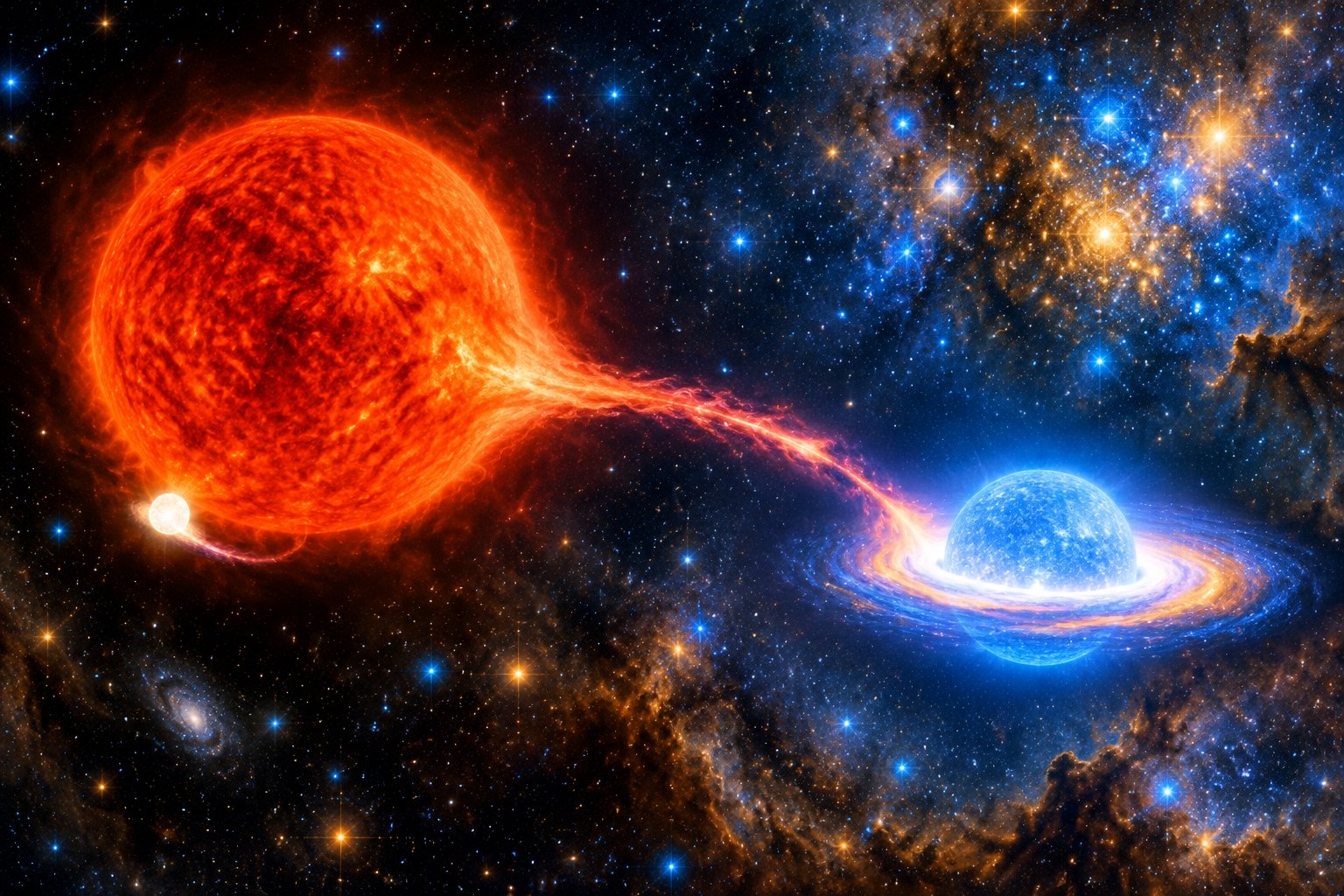
Una stella pu sembrare pi giovane perch si nutre della compagna: la gravit sottrae materia nel lobo di Roche, come nel sistema di Algol e nelle binarie a raggi X. Un legame che pu generare astri blu e oggetti compatti.
Astronomers using the Hubble Space Telescope identified seven white dwarf companions among twenty?one blue stragglers in the open cluster NGC?188, providing the first concrete evidence that mass exchange can reverse stellar aging.
How Stars Appear Younger Than Their Age
The discovery emerged from a survey led by Natalie Gosnell, who observed ultraviolet emissions that reveal hidden white dwarfs. These stragglers shine hotter and bluer than expected for their chronological age, as if they have been reinvigorated by stolen material. The findings, published in The Astrophysical Journal, show that two?thirds of blue stragglers in NGC?188 formed through some form of mass transfer rather than collisions or mergers.
| Category | Count | Observation |
| White dwarf companions | 7 | UV glow detected by Hubble |
| Other mass?transfer signs | 7 | Spectroscopic evidence of gas flow |
| Total blue stragglers | 21 | In NGC?188 cluster |
The Roche Lobe Mechanism: Gravity’s Gentle Theft
When the more massive star in a close binary expands into a red giant, its gravity can no longer hold the outer layers within its own Roche lobe. Material spills across the boundary, sometimes forming a luminous accretion disk around the companion. This process is a gravitational transfer of gas, not a violent collision, yet it can dramatically alter both stars. The donor star loses mass, contracts into a white dwarf, while the recipient gains bulk and appears unusually youthful.
Algol as the Classic Case Study
The Algol system exemplifies this paradox. In ??Librae, spectroscopic analysis of carbon?to?nitrogen ratios shows that mass transfer has been largely conservative, meaning little material escaped the binary. ESA/Gaia measurements pinpoint the orbital parameters, confirming that the originally massive star has shed over 1?solar mass to its companion. The resulting configuration mirrors the blue straggler phenomenon observed in NGC?188, demonstrating that the same mechanism operates across different mass ranges.
X?ray Binaries and the Broader Picture
Similar mass exchange powers X?ray binaries, where a compact object accretes matter from a donor star. The emitted X?ray spectrum and rapid brightness variations serve as diagnostic tools, much like the ultraviolet signatures used for blue stragglers. These systems illustrate how transferred material can fuel extreme physics, from hot accretion disks to gravitational?wave emitting ultra?compact binaries discovered by ATLAS and followed up with high?speed photometry.
From Blue Stragglers to Compact Objects
The outcomes of stellar cannibalism vary. Some pairs evolve into:
- detached white-dwarf binaries
- while others become cataclysmic variables
- or merge to form single, evolved stars.
In the extreme case of ATLASJ1013?4516, an 8.56?minute orbital period binary showcases stable mass transfer that could be detectable by the upcoming Laser Interferometer Space Antenna. Across these scenarios, the common thread is that a stars destiny is intertwined with its companion, reshaping evolutionary timelines beyond the initial mass alone.
Why Evolution Is a Partnership
In NGC 188, ultraviolet detections of white-dwarf companions and spectroscopic signs of gas flow point to mass transfer as a major route for forming blue stragglers. Together, these observations show how a companion can gain mass and appear younger while its donor evolves into a white dwarf.